Overthinking Again? Here's How to Quiet Your Mind in Under 10 Minutes
If your brain is currently running twelve tabs at once, replaying a three-day-old conversation, and somehow also catastrophising about something that hasn't even happened yet — welcome. You're in the right place.
You don't need a silent retreat or a one-hour meditation session to feel better. You need to understand what's actually happening in your brain when it refuses to slow down — and then give it a few specific, science-backed reasons to do so. Here's everything, broken down simply.
What's Actually Happening When You Can't Stop Overthinking?
Overthinking isn't a personality flaw. It's a brain pattern — and once you understand it, it becomes much easier to interrupt.
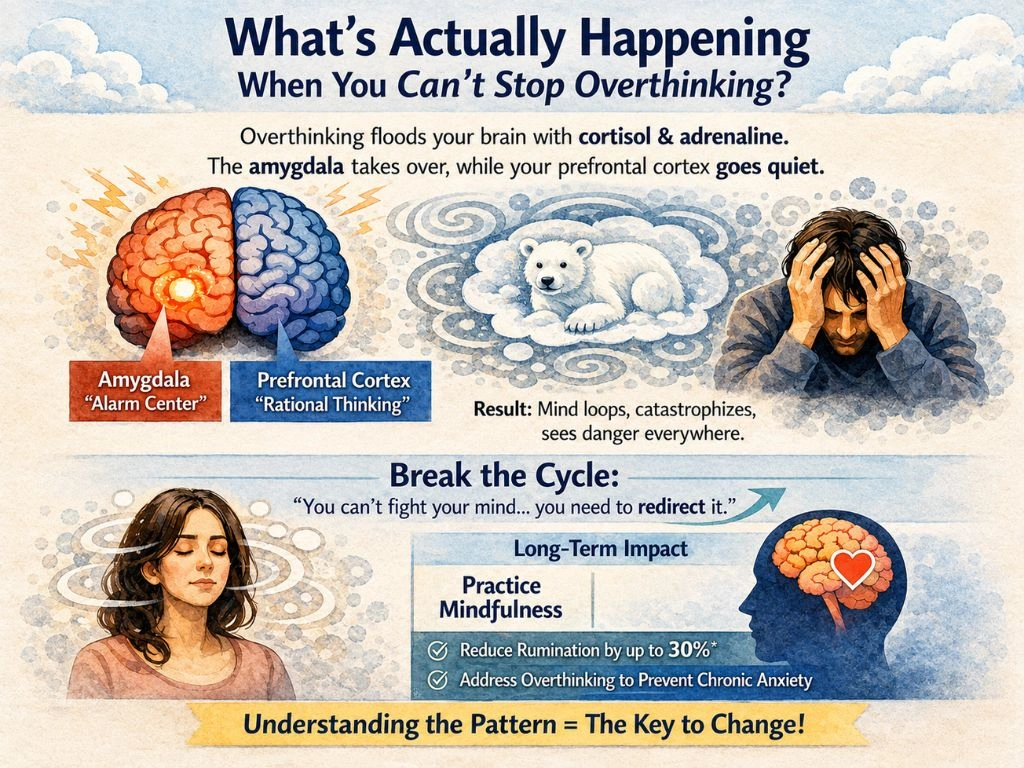
When you're stressed or anxious, your brain floods your system with cortisol and adrenaline. Your amygdala — the brain's alarm centre — takes over, while your prefrontal cortex, the part responsible for rational thinking and perspective, essentially goes quiet. The result is a mind that loops, catastrophises, and treats every uncertain situation as an emergency worth obsessing over.
Harvard psychologist Daniel Wegner demonstrated this with his famous "White Bear" experiment. When people were told not to think of a white bear, they thought of it more than once per minute. The harder you try to suppress a thought, the louder it gets. Fighting your mind directly almost never works. Redirecting it does.
Research confirms that sensory-based mindfulness practices can reduce rumination — the clinical term for looping, repetitive thinking — by up to 30%. And chronic overthinkers are significantly more likely to develop long-term anxiety if the pattern goes unaddressed. So this isn't just about feeling better in the moment. It matters long term too.
How Common Is This, Really?
Very. Studies show that 73% of adults aged 25 to 35 identify as chronic overthinkers. Even among people aged 45 to 55, that number is 52%. Stress levels have been rising consistently over the past decade, with digital overload, workplace pressure, and economic uncertainty listed as the biggest drivers.
Your restless, overworked brain is not unusual. It is responding to a genuinely demanding world. The goal isn't to eliminate thinking — it's to stop the kind of thinking that runs in circles and helps nothing.
7 Ways to Quiet Your Mind in Under 10 Minutes
These aren't generic wellness tips. Each one works through a specific, well-understood psychological or physiological mechanism.
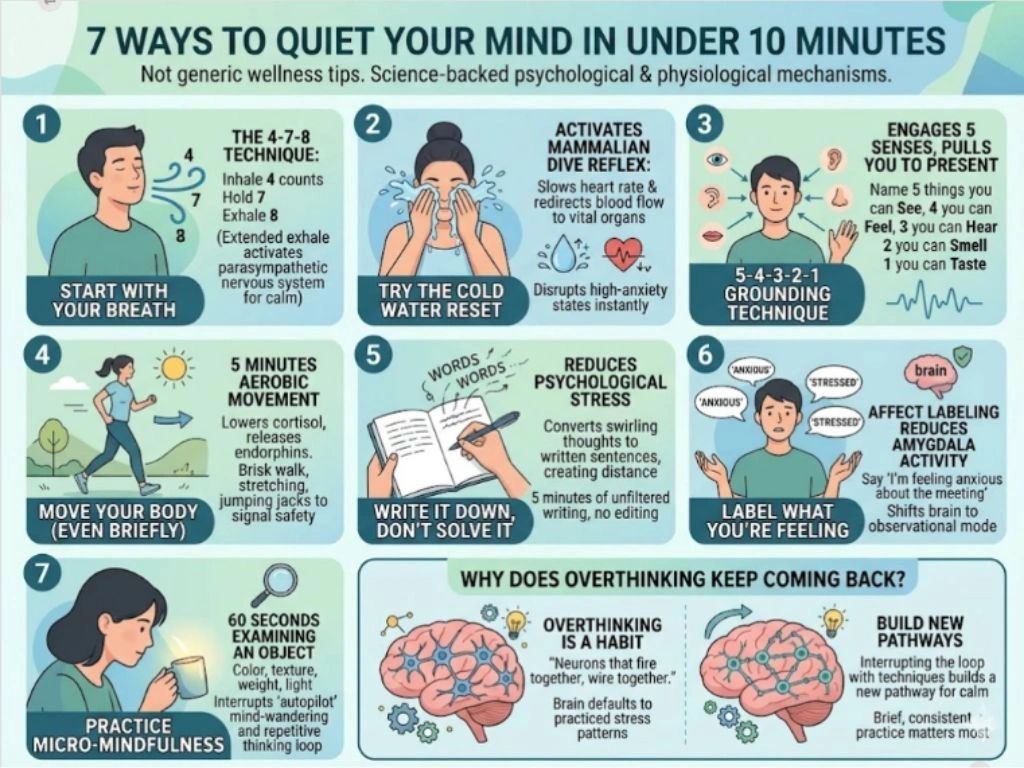
Start with your breath. When you're overwhelmed, your breathing becomes fast and shallow — which your nervous system reads as evidence that danger is real and ongoing. Slowing your breath intentionally sends the opposite signal. The 4-7-8 technique is particularly effective: inhale for 4 counts, hold for 7, exhale for 8. The extended exhale is what directly activates your parasympathetic nervous system — your body's built-in calm response. Repeat four times. Most people feel a noticeable shift within two minutes.
Try the cold water reset. Splash cold water on your face or hold something cold in your hands for 20 to 30 seconds. This activates what physiologists call the mammalian dive reflex — a hardwired response that automatically slows heart rate and redirects blood flow to your vital organs. It is physically very difficult to maintain a high-anxiety state when this reflex kicks in. It sounds too simple to work. It isn't.
Use the 5-4-3-2-1 grounding technique. Overthinking lives in the future — in "what if" and "what might go wrong." Grounding pulls you back to the present by forcing your brain to engage all five senses. Name 5 things you can see right now. Name 4 things you can physically feel — your feet on the floor, the chair under you, the temperature of the air. Name 3 things you can hear. Name 2 things you can smell. Name 1 thing you can taste. This is a deliberate shift from internal rumination to external reality, and neuroscience confirms it calms overactive brain activity quickly.
Move your body, even briefly. Just 5 minutes of aerobic movement — a brisk walk, jumping jacks, stretching — begins to lower cortisol and release endorphins that meaningfully improve mood and focus. Physical exercise is one of the most effective short-term interventions for anxiety and mental overload. If you're stuck indoors, standing up, shaking out your hands, and walking to a different room still signals to your nervous system that the threat has passed and it's safe to settle.
Write it down, don't solve it. Writing about what's worrying you — not to find answers, just to get it out of your head and onto paper — significantly reduces psychological stress. The act of converting a swirling thought into a written sentence creates distance from it. It goes from being inside you to being in front of you, which makes it feel smaller and more manageable. Five minutes of unfiltered writing, no editing, no rereading — that's all it takes.
Label what you're feeling. Simply naming an emotion — a process psychologists call "affect labeling" — reduces activity in the amygdala. When you say to yourself "I'm feeling anxious about the meeting" rather than just experiencing the anxiety, your brain shifts from reactive mode to observational mode. That shift alone reduces the intensity of the feeling. It's the same principle behind journaling and therapy — language gives the mind something to hold onto.
Practice micro-mindfulness. You don't need 20 minutes to meditate. Pick one ordinary object near you — a mug, a plant, a pen — and spend 60 seconds examining it fully. Its colour, texture, shape, weight, the way light falls on it. This is a deliberate interruption of the brain's "autopilot" system, which is responsible for mind-wandering and repetitive thinking. Brief but total engagement with something real breaks the overthinking loop faster than most people expect.
Why Does Overthinking Keep Coming Back Even After You Calm Down?
Because calming your mind once doesn't change the underlying habit — and overthinking is very much a habit.
Your brain has practiced this pattern, possibly for years. Neuroscience describes this with the phrase "neurons that fire together, wire together." Every time your brain defaults to overthinking in response to stress, that pathway gets a little stronger. But the reverse is also true: every time you interrupt the loop with a grounding technique, a breath, or a moment of stillness, you're building a new pathway — one that makes calm slightly more accessible the next time.
This is why daily practice matters more than occasional effort. Even brief, consistent mindfulness practice produces measurable changes in brain structure over time — particularly in the areas associated with attention, emotional regulation, and stress response. Small things done regularly are genuinely more powerful than big things done occasionally.
What Role Does Meditation Actually Play in All of This?

Meditation gets talked about so often that it has started to feel like a buzzword — something people say you should do without explaining why it actually works. So here's the honest version.
When you meditate, even briefly, you are not trying to empty your mind. That's a common misconception that stops a lot of people before they even start. Meditation is the practice of noticing when your mind has wandered — and gently bringing it back. That's it. The wandering is not failure. The noticing is the practice.
What makes this powerful for an overthinking brain specifically is what happens neurologically over time. Regular meditation strengthens the prefrontal cortex — the part of your brain responsible for rational thinking, decision-making, and emotional regulation — while reducing the reactivity of the amygdala, your brain's fear and alarm centre. In simple terms, you get better at thinking clearly and worse at catastrophising. That is exactly the shift an overthinker needs.
You don't need to sit in silence for an hour. Research consistently shows that five to ten minutes of daily, focused meditation produces real, measurable changes in brain structure and function within eight weeks. A study from Massachusetts General Hospital found that participants who meditated for an average of 27 minutes per day for eight weeks showed significant increases in grey matter density in areas linked to self-awareness, learning, and emotional regulation — and a reduction in grey matter in the amygdala. These are physical brain changes — not placebo, not mood — actual structural shifts.
For beginners, the simplest approach is breath-focused meditation. Sit comfortably, close your eyes, and focus entirely on your breath — the sensation of air entering and leaving your nose, the rise and fall of your chest. When a thought comes in — and it will, within about four seconds — you simply notice it, let it pass, and return to the breath. Every time you do that, you are training the exact neural circuit that breaks overthinking. It feels small. It compounds quickly.
If sitting still feels too hard at first, body scan meditation is a gentler entry point. Starting from the top of your head, slowly move your attention down through each part of your body — scalp, forehead, jaw, neck, shoulders, chest — noticing any tension without trying to fix it. This keeps the mind anchored to something physical and is particularly effective at releasing the stored tension that overthinking tends to create in the body.
The most important thing about meditation is not how long you do it. It's that you do it regularly. Ten minutes every day will do more for an overthinking mind than an hour once a week. Consistency is the entire mechanism. Your brain changes through repetition — and meditation is simply the deliberate repetition of calm.
If You're Drawn to Spiritual Practice — A Note on Japa Mala
Not everyone connects with ritual and that's perfectly fine. But if you're someone who finds meaning in spiritual tools alongside the practical techniques above, a Japa Mala is worth knowing about — and worth using correctly.
A Japa Mala is a string of 108 beads traditionally used in Hindu and Buddhist meditation for counting mantra repetitions. The number 108 is considered sacred in Vedic cosmology — it appears across ancient scriptures, astronomical calculations, and yogic traditions. The practice of Japa meditation, which involves the rhythmic repetition of a mantra or sacred sound while moving bead to bead, is one of the oldest documented forms of meditation in the world.
The reason a mala works for an overthinking mind is actually very practical. The rhythmic, repetitive motion of moving bead to bead gives your restless hands something to do and gives your mind a single, clear point of focus. That combination is surprisingly effective at interrupting thought loops. It's the same mechanism behind prayer beads, rosaries, and worry beads — tools that appear in almost every major spiritual tradition across human history, for good reason.
A Word on the 10 Mukhi Japa Mala

Among the different types of rudraksha malas used in Japa practice, the 10 Mukhi Japa Mala holds a particular place in Vedic tradition. The 10 Mukhi Rudraksha — a seed from the sacred Rudraksha tree with ten natural faces — is associated with Lord Vishnu and his ten avatars. It is believed to offer protection from negative energy, support emotional balance, and enhance mental clarity during meditation.
What makes the 10 Mukhi significant for someone dealing with an overwhelmed or scattered mind is its traditional association with the ten directions — the Dikpalas in Vedic cosmology. It is said to create a sense of energetic stability and groundedness, making it easier to stay focused during mantra practice. Sages and spiritual practitioners have used it specifically during Japa meditation for centuries, particularly for those who struggle with mental restlessness.
If you already have a meditation practice or are building one, and you feel drawn to the rudraksha tradition, a 10 Mukhi Japa Mala is a considered choice — not because it does the work for you, but because it gives your practice a tactile anchor that builds consistency. Hold it, move through it bead by bead, pair it with a simple mantra like "Om Namah Shivaya," and over time your mind begins to associate its weight and texture with stillness.
That's not mysticism. That's how the brain builds habits.
The Honest Bottom Line
Your overthinking mind is not your enemy. It is trying to keep you safe — it has simply gotten very, very overenthusiastic about the job.
The techniques in this article work because they interrupt the stress loop at different entry points — breath, body, senses, language, focus, and rhythm. You don't need all of them. Start with one that feels natural today. A few slow breaths. Cold water on your face. Five minutes of writing. One round of beads.
The goal isn't to never think again. It's to choose when you think, about what, for how long. That's not a small thing. That's actually a pretty good definition of a calm life.