Feeling Stressed All the Time? Here's the Daily Routine That Actually Helps
Let's be honest — stress doesn't feel like a big dramatic breakdown most of the time. It feels like a low buzzing in the background. Like you can never fully switch off. Like you finish one task and immediately start worrying about the next three. Like even your weekends don't feel restful anymore.
If that sounds familiar, you're not alone — and you're not exaggerating. According to Gallup's 2025 World Poll, 37% of adults globally say they feel stressed every single day. That's more than one in three people walking around carrying a weight they can't quite put down. The good news is that stress responds to very small, very consistent changes in your daily life. You don't need a sabbatical. You need a slightly different routine.
What Is Stress Actually Doing to Your Body?
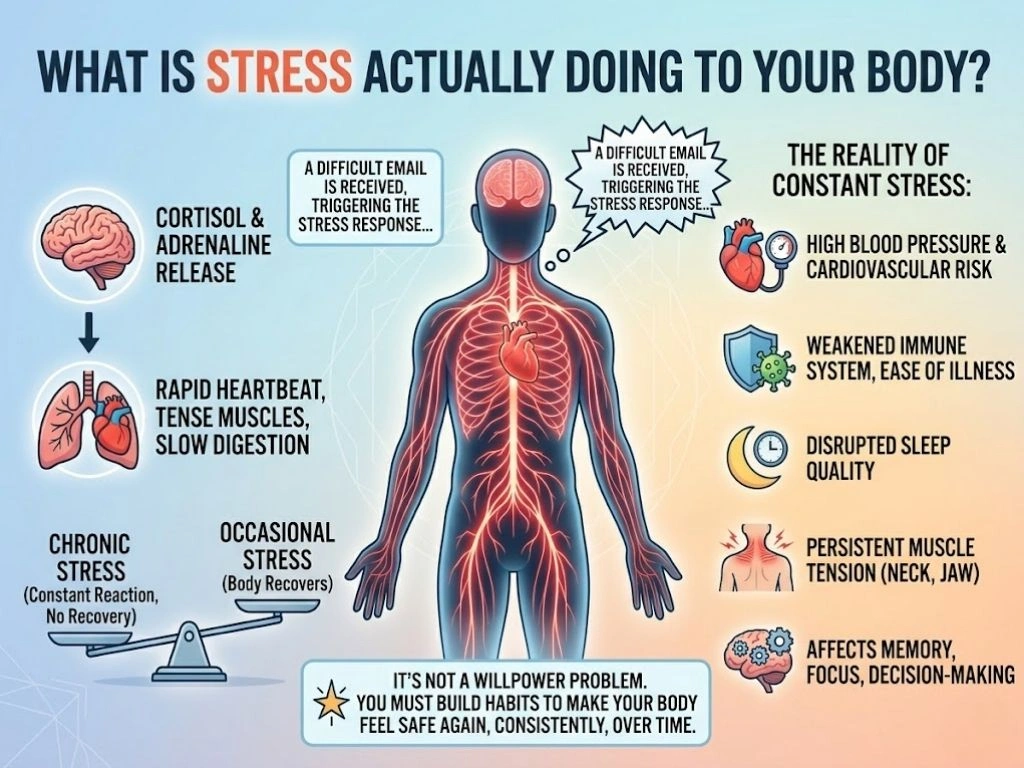
Stress isn't just in your head — your body is physically reacting to it every single time it hits.
When something stressful happens — a difficult message, a money worry, a conflict — your brain immediately releases cortisol and adrenaline. Your heart speeds up, your muscles tighten, your digestive system slows down. This is your body preparing to fight or run from danger. The problem is that your nervous system can't tell the difference between a genuine emergency and a difficult email. It reacts the same way to both.
When this happens occasionally, your body recovers fine. But when stress is constant, the body never gets to recover. And that's when things start going wrong. Here's what chronic stress actually does:
- Raises blood pressure and increases cardiovascular risk significantly
- Weakens your immune system — you get sick more easily and recover slower
- Disrupts sleep quality, even when you're getting enough hours
- Causes persistent muscle tension — that tight neck and jaw you've probably just accepted as normal
- Affects memory, focus, and decision-making over time
Research published in JAMA Psychiatry found that people under prolonged stress are two to four times more likely to develop serious health conditions. This isn't a willpower problem. You can't "calm down" your way out of a physical stress response. You have to build habits that help your body actually feel safe again, consistently, over time.
Why Does Everything Feel More Stressful Than It Used To?
Because it genuinely is — and that's not you being soft.
A study published in BMC Public Health found that psychological stress got worse in 85% of countries between 2008 and 2021. The biggest jump was in people aged 17 to 45. Here's why:
- Work pressure and job insecurity — 69% of employed adults call work a major stressor (APA, 2025)
- Financial anxiety — two thirds of people name money as a significant source of stress
- A 24-hour news cycle and social media that never truly switches off
- The complete blurring of work life and home life — especially post-pandemic
- Rising cost of living, housing stress, and general economic uncertainty
So if it feels harder than it should — it objectively is. You're not weak. You're just human, in a world that's moving faster than human nervous systems were built for. The solution isn't to toughen up. It's to build a daily routine that gives your nervous system regular moments of actual rest.
7 Daily Habits That Actually Bring Stress Down
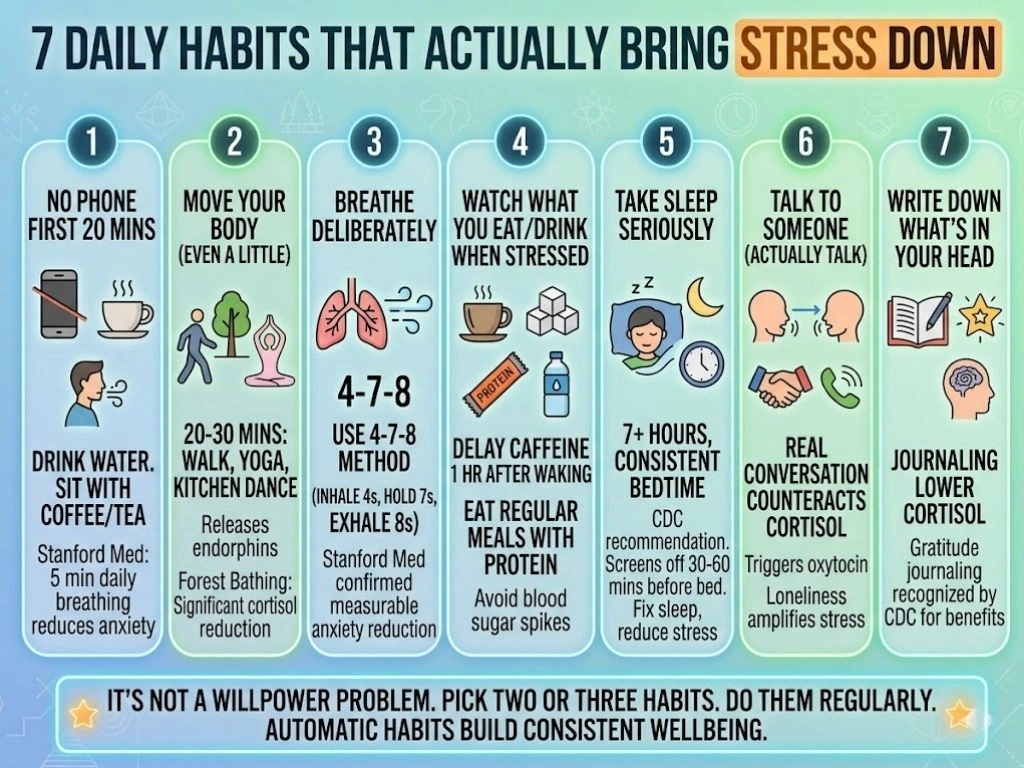
None of these are revolutionary. But they work — because they directly interrupt the stress cycle at different points in the body and mind. You don't have to do all of them. Pick two or three that feel possible, and do them regularly enough that they become automatic. That's where the shift happens.
The first thing most people do after waking up is check their phone. That means the first input their brain gets — before it's even fully awake — is a flood of notifications and other people's problems. That immediately activates stress before the day has even started.
Try keeping the phone face down for the first 20 minutes. Drink water. Sit with your tea or coffee without scrolling. It sounds almost embarrassingly simple, but Harvard Medical School research shows that even a short morning meditation reduces cortisol meaningfully over time. Stanford Medicine found that five minutes of daily breathing is enough to reduce anxiety. Morning is the easiest window to build both — before the day creates a hundred reasons not to.
Move your body — even a little
Exercise is probably the most well-backed stress tool that exists. It releases endorphins, brings cortisol down, and gives your body a healthy outlet for all the physical tension that stress builds up. You don't need a gym membership or an hour-long session. Twenty to thirty minutes of movement — a walk, light yoga, even dancing around your kitchen — produces real effects on how you feel.
If you can do it outside, even better. Research on forest bathing — spending time walking among trees — found that 20 minutes in a natural environment reduces cortisol significantly more than the same walk in an urban setting. Your body genuinely responds to greenery. It's not woo — it's biology.
Breathe deliberately — once a day is enough to start
Breathing is the only thing your body does automatically that you can also consciously control. When you're stressed, your breathing becomes fast and shallow without you noticing — and that pattern signals to your brain that the threat is still ongoing. Consciously slowing it down reverses that signal.
Try the 4-7-8 method: inhale for four counts, hold for seven, exhale for eight. Do it four times. Stanford Medicine confirmed that five minutes of daily breathwork produces measurable anxiety reduction. One song's worth of time, once a day. Genuinely one of the highest-return habits on this list.
Watch what you eat and drink when stressed
Most people reach for caffeine and sugar when stressed — which is understandable but makes things measurably worse. Caffeine mimics the physiological effects of stress by raising cortisol. Sugar causes blood glucose spikes and crashes that translate directly into mood instability and heightened anxiety.
Small changes help a lot here: delay your first coffee by an hour after waking — just letting cortisol's natural morning peak settle first — and eat regular meals with some protein to keep blood sugar stable. Food is affecting your body chemistry all day long. Getting this even slightly more right has a bigger impact on stress than most people realise.
Take sleep seriously — it's not a luxury
Stress makes sleep harder. Poor sleep makes stress worse the next day. It's one of the most vicious cycles in mental wellbeing — and also one of the most solvable, if you treat sleep as genuinely non-negotiable.
The CDC recommends seven or more hours for adults. But consistency matters as much as duration — going to bed and waking up at roughly the same time every day regulates your body clock and improves sleep quality significantly. Avoiding screens for 30 to 60 minutes before bed is the single change with the most consistent research behind it. Chronic stress reduces the quality of deep sleep even when total hours look fine — which is why you can sleep eight hours and wake up exhausted. Fix sleep and stress together, not separately.
Talk to someone — actually talk, not just text
This one gets dismissed as too obvious, but the research is striking. Quality social connection — real conversation with someone you trust — triggers oxytocin, a hormone that directly counteracts cortisol. It physically calms your nervous system. The APA's 2025 report found that more than half of people experience regular loneliness, with the vast majority also reporting physical symptoms of stress.
It doesn't have to be a long deep conversation. A ten-minute phone call with someone you feel safe with, a shared meal, a genuine exchange where you feel heard — these do something that no amount of solo stress management can fully replicate. Loneliness amplifies the stress response. Connection quiets it.
Write down what's in your head — five minutes is enough
Journaling sounds like advice for teenagers with diaries, but the research behind it as a stress tool is genuinely solid. Writing about what's worrying you — even briefly, even messily — moves thoughts from inside your head to in front of you. That shift creates just enough distance to reduce the emotional intensity. Multiple studies show this lowers cortisol. The CDC recognises gratitude journaling — writing three specific things from your day that went okay — as having measurable wellbeing benefits.
Five minutes before bed. That's all it takes to start seeing the difference.
What Happens When the Routine Falls Apart?
It will. Life happens — travel, illness, bad weeks, days when everything goes sideways. That's completely normal, and missing a day doesn't undo progress. Here's the one thing to remember:
The goal isn't perfect consistency. It's quick recovery. Noticing you've slipped, without beating yourself up about it, and simply starting again the next day. Research on habit formation consistently shows that how fast you return matters far more than whether you broke it in the first place. A ten-minute walk every day for a year will do more for your stress than a ten-day wellness retreat followed by nothing.
_1780033774.webp)
If You're Drawn to Spiritual Practice — A Note on Finding Stillness
Every major spiritual tradition across history has included some form of daily ritual. Not because ritual is magic, but because the human nervous system genuinely responds to rhythm, repetition, and intentional stillness — in ways that science is only now fully documenting.
In Vedic tradition, the concept of dinacharya — daily routine — is built on exactly this idea: that caring for yourself through small, consistent daily acts builds a kind of resilience that stress cannot easily penetrate. Mantra meditation works particularly well here because it gives the mind a specific sound to hold — unlike silent meditation, where the mind can still drift into worry. The repetition both focuses the mind and calms the nervous system simultaneously. For people who find silent meditation frustrating, mantra is often the easier and more effective entry point.
A Word on the Sphatik Mala
_1780033786.webp)
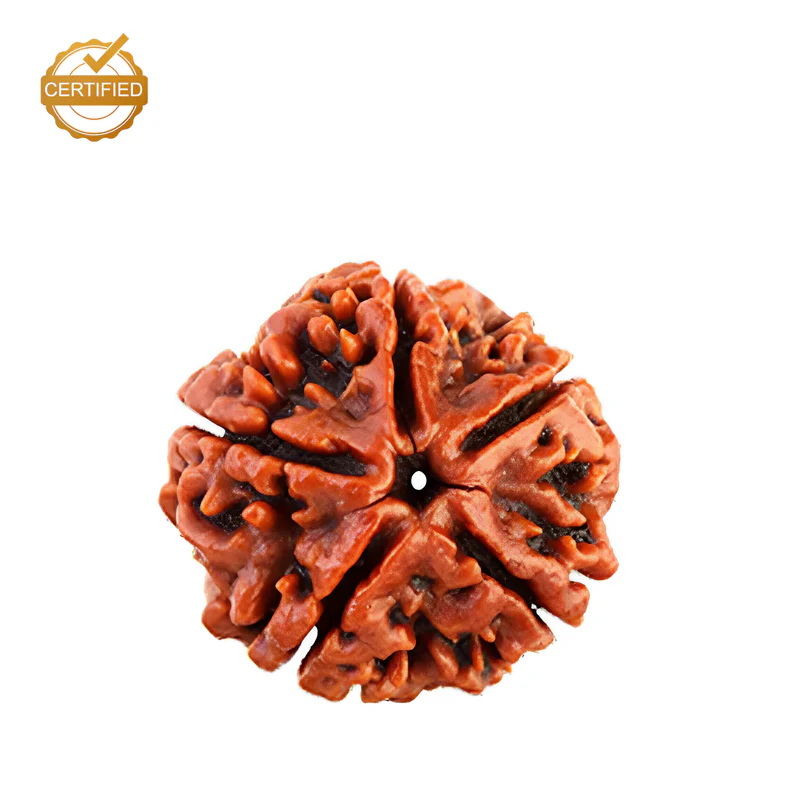
For those who use a mala in their practice, the Sphatik Mala — made from clear quartz crystal — is one of the most recommended options specifically for stress and mental overwhelm in Vedic tradition. Sphatik is associated with cooling, calming energy in Ayurvedic philosophy — believed to absorb and neutralise the kind of excess mental tension that chronic stress creates. It's considered gentle and universally suitable, which is why it's often recommended first for people new to mala practice or those specifically dealing with anxiety.
Using a Sphatik Mala during breathwork or mantra practice gives the restless mind something physical to hold onto — a tactile anchor that makes it easier to stay present instead of drifting back into the worry spiral. Over time, your brain starts to associate the feel of the beads with the calm you've built around them. That's not mysticism — that's how the brain builds associations through repetition. Any consistent ritual eventually becomes calming on its own.
The Honest Bottom Line
Stress isn't going away — the world isn't becoming less demanding. But your ability to handle it, recover from it, and not let it quietly run your life is something you can genuinely build. Not through a dramatic overhaul, but through small daily shifts that add up over weeks and months into a noticeably different baseline.
To make it easy, here's a simple starting point:
- Morning: No phone for 20 minutes + 5 minutes of breathing
- Daytime: A 20-minute walk — outside if possible
- Evening: 5 minutes of journaling + consistent bedtime
- Anytime: Call someone you trust. Drink water. Breathe slowly.
Pick one thing from that list. Just one. Do it for two weeks. See how it feels. Then maybe add another. That's how this works — quietly, steadily, in a direction your nervous system will genuinely thank you for.
The goal was never a stress-free life. It was a life where stress visits — and knows its way out.